19ª Exposición Internacional de Arquitectura, La Biennale di Venezia
10 mayo - 23 noviembre 2025
(visita previa 8 y 9 de mayo)
Curadora: Azza Aboualam
Título: Pressure Cooker
Comisariado:
Salama bint Hamdan Al Nahyan Foundation
Con el apoyo del Ministerio de Cultura de los EÁU
Sede: Arsenale - Sale d'Armi
Vea contacto y ubicación
Open Call for Proposals 2027
Curatorial Concepts for the UAE Pavilion at the 20th Venice Architecture Biennale 2027
Architects, designers, artists, historians, and researchers with experience working or studying in the UAE or the broader MENASA region are invited to submit concept proposals that tell an untold story from the UAE’s architectural discourse. Deadline: 30 September 2025
more information
The National Pavilion UAE at the 19th International Architecture Exhibition at La Biennale di Venezia opens with Pressure Cooker, curated by Azza Aboualam, Emirati architect and Assistant Professor at Zayed University and Co-founder of Holesum Studio. The exhibition poses a central research question: Using the UAE as a case study, how can architecture contribute to greater food security?
As climate change disrupts agricultural systems, traditional farming methods face mounting threats, from soil degradation to temperature extremes. Drawing on archival and contemporary research in the UAE, the exhibition examines how architecture can respond to these challenges by proposing a series of experimental adaptive greenhouse assemblies for arid landscapes. It situates the UAE’s agricultural landscape within a broader global context, exploring how architectural thinking can support versatile and resilient food production practices at both individual and community scales.
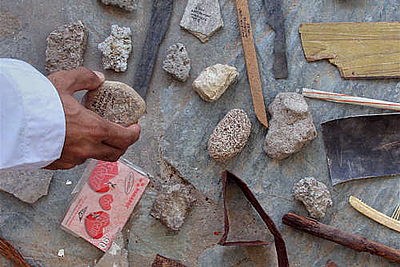
Developed through a threefold research methodology combining archival research, fieldwork, and design-build experimentation, Pressure Cooker introduces a modular kit-of-parts for greenhouse assemblies, specifically catering to hot, arid climates. The kit breaks down the architectural vocabulary of the greenhouse into its basic components: roof, wall, floor, tools, and materials. These can be reconfigured in multiple ways, allowing for different combinations that respond to specific climatic conditions and crop requirements. The approach proposes a future in which food production and architectural form are intertwined and can be integrated throughout our built and lived environments.


In the exhibition, visitors encounter a series of experimental greenhouse assemblies constructed using different combinations of the kit’s components. Each assembly represents a distinct combinatory scenario, exploring how inputs, such as sunlight, shading, external temperature, irrigation, ventilation, and thermal mass—and outputs such as interior temperature, light levels, humidity and energy use—can be negotiated through architectural form. These inputs and outputs also influence crop yield and inform the most effective ways to design and configure each greenhouse assembly. In response to the type of assembly and its intended food growing category, the exhibition includes crops with regional and historical significance—such as cucumbers—while other assemblies demonstrate the ability to grow species rarely associated with desert climates, such as blueberries.
The greenhouse assemblies presented in the exhibition respond to environmental challenges specific to the UAE, while also serving as a testing ground for how such structures might adapt to different contexts—such as Venice. Led by Aboualam, and developed in collaboration with Holesum Studio and a local team based in the UAE, the installation’s research and design explores the adaptation of greenhouses for arid environments when situated in an alternative, temperate climate. As part of this living experiment, Pressure Cooker collects, analyzes, and shares data, offering insights into each assembly’s environmental performance. The project brings together site-specific cultivation in Venice with research rooted in the UAE—affirming architecture’s role in shaping dynamic, adaptable food infrastructures across diverse climates.
By breaking down and recombining the architectural vocabulary of the greenhouse, Pressure Cooker invites visitors to reconsider how food, architecture, and new conceptions of space can intersect. The installation is accompanied by multimedia and audio material that traces the exhibition’s research phases, inviting visitors to join the research team on the journey, all the while offering insight into the project’s methodology and vision.

"Pressure Cooker," curated by Azza Aboualam, was inaugurated by His Excellency Sheikh Salem bin Khalid Al Qassimi, UAE Minister of Culture, in the presence of His Excellency Sheikh Khalifa Bin Ahmed Al- Khalifa, President of Bahrain Authority for Culture and Antiquities, and Mohammed bin Redha, Assistant Secretary-General for the Antiquities and Museums Sector at the National Council for Culture, Arts, and Letters (NCCAL), Kuwait.
Image Courtesy of National Pavilion UAE - La Biennale di Venezia. Photo by Nino Consorte of Seeing Things.
His Excellency Sheikh Salem bin Khalid Al Qassimi, UAE Minister of Culture, commented: "Architecture shapes our interactions with the environment and holds the potential to drive sustainable solutions for the future. The National Pavilion UAE’s participation at the Biennale Architettura 2025 reaffirms our dedication to global dialogue on innovation in design. Pressure Cooker illustrates how local design solutions can contribute to new perspectives on sustainable urban living."
H.E. added: “Over the years, the National Pavilion UAE has become a vital platform for showcasing the depth and diversity of the UAE’s creative and intellectual landscape. With each edition, it continues to elevate the voices of homegrown talent, foster cross-cultural exchange, and position the UAE as an active contributor to global conversations on architecture, art, and design. Its growing recognition reflects the dynamic and evolving nature of the country’s cultural scene—and its commitment to shaping a sustainable, interconnected future through creativity.”
Angela Migally, Executive Director, Salama bint Hamdan Al Nahyan Foundation, stated: “Through our longstanding partnership with the National Pavilion UAE, we remain committed to creating space for meaningful conversations that deepen connections and inspire new ideas. Growth, understanding, and dialogue are essential to the continued evolution of the UAE’s extraordinary architecture, art, and culture community. We are delighted to support Pressure Cooker and its timely exploration of resilience and the power of design in shaping a shared and sustainable future.”
Laila Binbrek, Director, National Pavilion UAE, commented: “The National Pavilion UAE continues to play a leading role in shaping the UAE’s cultural landscape, fostering impact and legacy through initiatives that support architectural discourse in the UAE. This is reflected in Azza Aboualam’s journey, who first engaged with the Pavilion as an intern in 2014. This year’s exhibition introduces a new critical lens yet to be pursued at this scale and within this context, proposing a technical and experimental approach to architecture that is future-thinking, multidisciplinary, and thoughtfully connected to the climate realities of our time.”
Azza Aboualam, Curator, remarked: “As the world undergoes an ongoing agrarian transition and faces the growing threats of climate change, the challenges to food and water security are becoming increasingly urgent, particularly in the Gulf region. While prevailing global perspectives on food security often emphasize centralized technological innovation, Pressure Cooker proposes an alternative: creating a shared responsibility for local communities. It looks into local design solutions that remain unexplored and were conceived under conditions of food scarcity over the years, ranging from the vernacular to the technologically sophisticated. The exhibition examines how architecture can help identify and address challenges in food production, bringing the UAE closer to its food security goals. With its multipronged research approach, Pressure Cooker aims to contribute to the national development of ensuring sustainable food production and strengthening local agriculture, all the while aiming to create an open source of knowledge for arid environments and the world at large.”
The National Pavilion UAE continues its commitment to supporting educational and research opportunities through collaborations with institutions such as Zayed University and Silal. The 2025 Venice Internship Program will provide students and aspiring professionals from the UAE with firsthand experience in international architectural exhibitions.
Professor Michael Allen, Acting Vice President of Zayed University, added: "The partnership between Zayed University and the National Pavilion UAE is an example of our commitment to advancing creativity through research, education, and collaboration. We are immensely proud to be supporting Professor Azza Aboualam’s groundbreaking work Pressure Cooker, which investigates the evolving relationship between architecture and food production in the UAE. The project offers our students and faculty direct engagement with groundbreaking architectural research. This collaboration shows how bold ideas and academic innovation can have a real-world impact that is locally rooted yet globally resonant.”
Pressure Cooker Recipes: An Architectural Cookbook
A publication titled Pressure Cooker Recipes: An Architectural Cookbook, edited by Azza Aboualam, published by Kaph Books, accompanies the exhibition. Blending research, essays, and creative contributions, it reflects on the intersection of architecture and food production over time. Using a cookbook format divided into five main chapters, the texts and illustrations highlight agrarian practices in arid environments and beyond, offering new perspectives on our relationship with food production, climate-adaptive design, and urban infrastructures. Contributors include, in alphabetical order: Sarah Saad Alajmi, Rashed Almulla, Dimitri Brand, Kit Elsworth, Huma Gupta, HOME-OFFICE (Daniel Jacobs and Brittany Utting), Elisa Iturbe, Kevin Mitchell, and Faysal Tabbarah.
Pabellón Nacional de los Emiratos Árabes Unidos
Arsenale - Sale d'Armi
Bienal de Venecia
Ubicación en el mapa
Sitio web:
nationalpavilionuae.org
Redes Pabellón Nacional de los EÁU:
Facebook | Instagram
hashtag #UAEinVenice
Contactos de prensa:
Dana Al Sadek, Pabellón Nacional de los Emiratos Árabes Unidos
dana(at)nationalpavilionuae.org
+971 55 140 0876
Florian Vanicatte, Send/Receive
florian(at)sendreceive.eu
+33 6 17 21 69 32
De informaciones de prensa. Trad. del inglés: Universes in Universe.
© Foto portada: Ismail Noor of Seeing Things, cortesía National Pavilion UAE – La Biennale di Venezia.